Showing posts with label Pilgrim's Quill Studio. Show all posts

Thursday, August 1, 2013

Calligraphy for an Elegant Wedding

I  LOVE that there are brides, grooms,and wedding designers out there who feel the way I do 
about incorporating calligraphy into a wedding, making the smallest details unforgettable. 

I have had the pleasure of working several times with Sinclair & Moore Events (formerly Steven Moore Designs) and Brittany O'Brien of Spruce Stationery & Design.  This creative team pulls out all the stops when it comes to designing gorgeous weddings.  When their clients, Andrea and Som, wed last Fall, a bit of Pilgrim's Quill Calligraphy added a flourish to their special day—from Seattle to India, and New York to Germany and Sweden...


The invitations were mailed in boxes—
white ink in gray... 


...the dessert menu informed guests of the delectable selections awaiting them...


...and the Guest Book sign invited guests to leave memories for years to come.
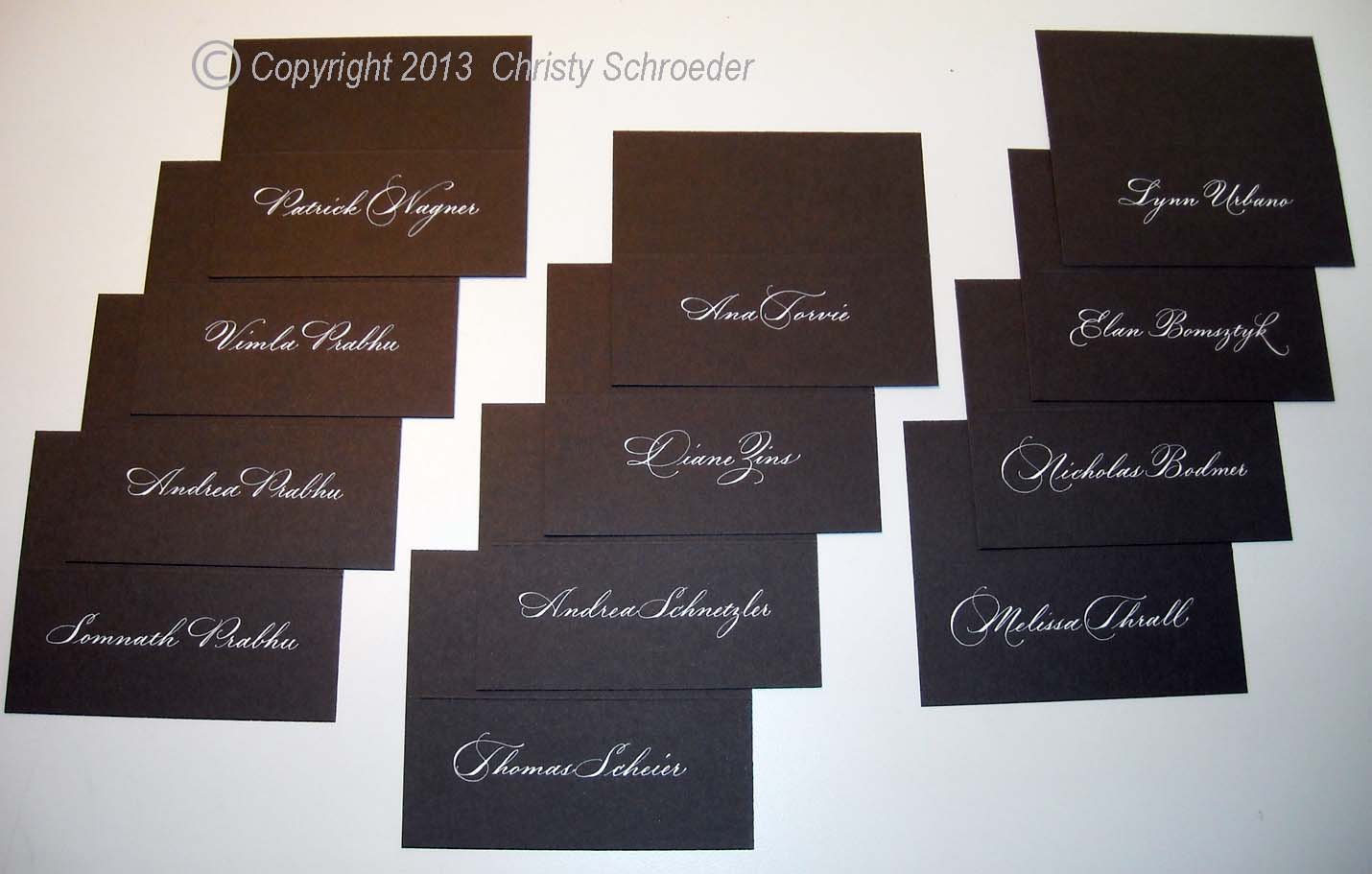


Simple, yet elegant, placecards adorned each place setting.


But the largest calligraphy project for this wedding was the seating chart.  Here are photos of my step-by-step process in its creation...


Creating a Seating Chart


Seating charts can be organized a number of ways, and it's always helpful to work with a wedding designer who has a specific idea of what they want done.  Sinclair & Moore Events prefers a chart organized alphabetically by last name, rather than by table number, making it much easier and faster for guests to locate themselves on the chart.


First, I determine the number of names per alphabet section.  My column divisions are then determined based on the number of names in each section, trying to balance the overall chart vertically.


Next, I write the longest name followed by the table number, to determine how large the writing can be and the overall column width.  The perimeter margin space and necessary column width will tell me how much space I can leave between columns.
Space for the heading and the title is also measured.


I create a scale diagram on graph paper with all of the measurements, taking lots of notes as I proceed.  A very wise book maker (thank you Michael Jacobs!) always says, "Measure twice, cut once!"  The same applies to calligraphy when there is no room for error.  All of the measurements are then transferred confidently to the large paper and ruled with white chalk pencil (Fons & Porter). 


 With measurements in place, the heading is written first because it is the largest and most crucial—if I make a mistake here, at least I have not written the entire chart!  I write the heading on a separate paper that acts as a placement and measuring guide, placed above the area I will be writing.  (Some prefer to lightly pencil in the text and ink over it, but I find I lose some of the spontaneity in my writing with this method.)


With the completed title in place, it's time to begin the bulk of the chart...


...section by section, no distractions, and a block of time that I can complete as much as possible in one sitting or one day. 


When the ink is completely dry and the information has been proofread for errors (Yikes!  Heaven forbid!), the chalk lining is erased carefully and the chart is ready for the big day!


Wednesday, June 12, 2013

What's In a Name?


"The visitor goes through the place; the place goes through the pilgrim."

-Robert Cooper


In 2005 I traveled to England with my mentors, Stan and Denys Knight, and a calligraphy study group. Together we visited sites of great historical significance in the development of calligraphy and manuscripts. 

Meandering through small villages, sitting in ancient churches and cathedrals, and standing on the coastline among monastery ruins, I discovered a profound connection to calligraphy through an ancestry of scribes and the words they had written. My journey became a pilgrimage of discovery; hence, the name Pilgrim's Quill Studio was born. Pilgrim, in this sense, defines me as an artist blessed to be journeying through an art form with an ancient lineage.

The Journey 


South Cottage, Ditchling, East Sussex


This was my home for four days—a cozy B & B owned and operated by a former stage actress. That's "my room" in the right dormer, with a lovely view of the South Downs.

"Downtown" Ditchling


Ditchling was home to Edward Johnston, the "father of modern calligraphy", in the early 1900's. The local museum displays some of his work, as well as his writing desk, stained with ink.


headstone of Edward & Greta Johnston


I had to visit the grave site of Edward Johnston (b. 1872, d.1944) and pause for a moment, just to say thank you for his efforts that revived serious studies of calligraphy.


Durham Cathedral from the River Walk


Next, we traveled to Durham Cathedral. 
For three days we viewed manuscripts, toured the Cathedral, and gained a time and place context for the Lindisfarne Gospels, the topic of our study in the days ahead. This late 7th century manuscript is said to have been scribed by one individual, in honor of St. Cuthbert who was Prior of the monastery at Holy Island in that century. Durham Cathedral houses the relics of St. Cuthbert to this day.


Durham Cathedral Triforium


"Many of the 600,000 visitors each year may not think of themselves as pilgrims, but the regular daily services and prayers of individuals are still, as always, at the heart 
of the Cathedral's life, its main purpose."
(Quoted from a sign at the exit of the Durham Cathedral Treasury) 


Priory ruins, Holy Island, northern England


After Durham, we spent four days on Holy Island, 
studying the Half-Uncial script and display capitals of the Lindisfarne Gospels manuscript.


Priory ruins, Holy Island


Feeling the bitter cold that numbed my fingers as I walked through the Priory ruins, I tried to imagine the life of a 7th century scribe living on the cold northern coast—exposed not only to the elements, but the threat of Viking invaders wanting to destroy this way of life. 


The procession of Cuthbert's body; sculpture by Fenwick Lawson

 I returned home from this trip with an even greater sense of my passion for lettering, but full of questions too—about my place and purpose as a calligrapher. 
 

From my journal: "Calligraphy is the surface label—there is so much more, and it is that 'something more' that I am now seeking and will try to find the answer.  Faith, the spirit behind my hand and the hands of those before me, the history and tradition of this art and the spirituality behind it, and the strongest, deepest longing within me to decipher this labyrinth of connections.  There is meaning here that cannot be put into words yet."  

 
Cuthbert's Island—solitude and meditation

Eight years later, I still don't know that I have found a way to fully describe my experience in England, other than through the words of one of my favorite calligraphers, Ewan Clayton:

"I need not worry whether I am an artist or a craftsman.  
Nor need I waste time arguing that calligraphy should be taken seriously
because it is an art like dance or music.
It is something in its own right entirely, with an ancient lineage and a deep responsibility."

-from, Calligraphy of the Heart